
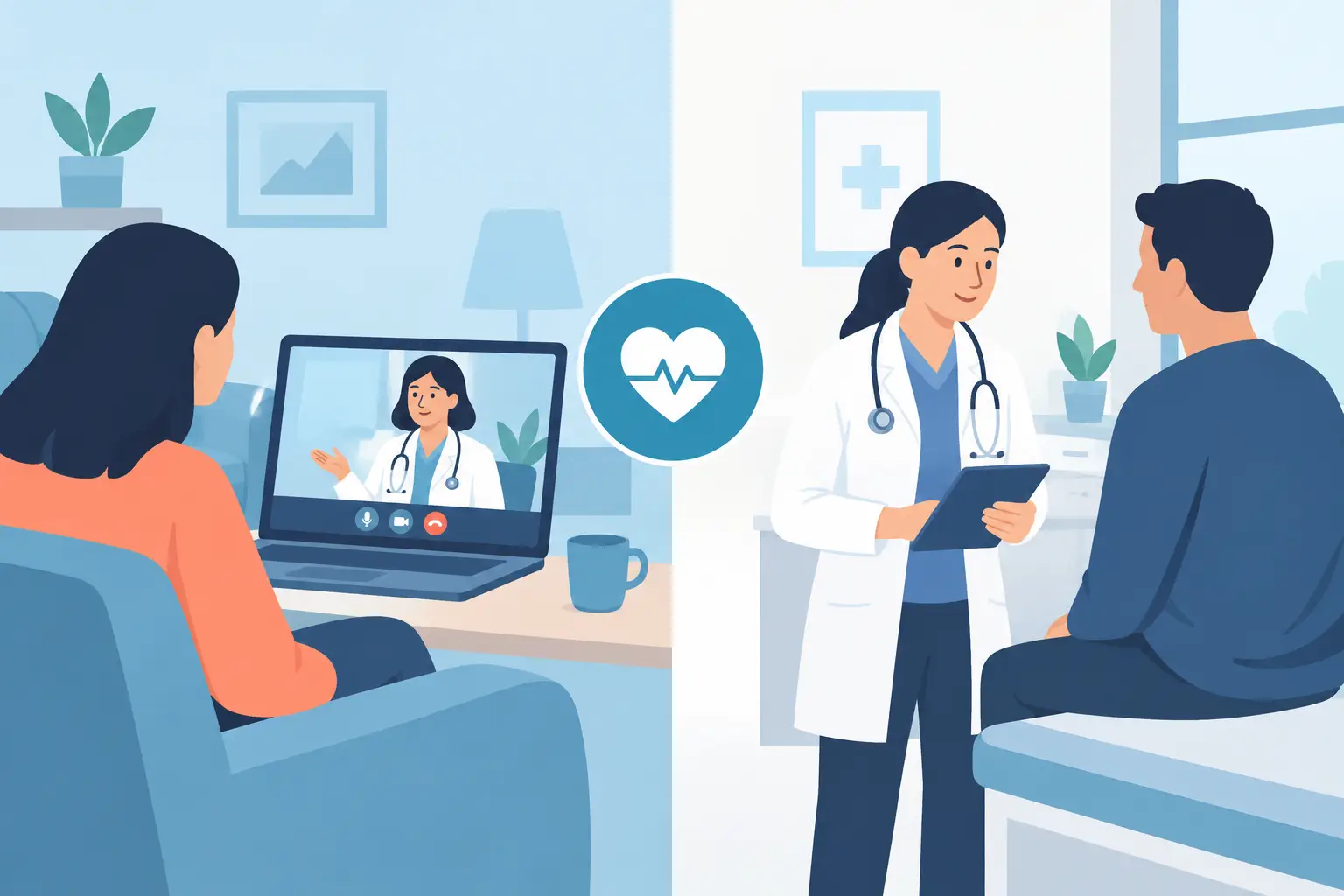
A sore throat starts the night before a busy workday. Your child develops a rash after school. You need a medication question answered, but you are not sure whether it requires a trip to a clinic. These are the everyday decisions that make telehealth versus in person care more than a matter of convenience.
Both options can help you get timely medical support for non-emergency concerns. The right choice depends on your symptoms, whether a hands-on exam or testing is needed, and how quickly your condition may be changing. Knowing where each option fits can save time while helping you get the appropriate level of care.
When Telehealth Can Be a Good Choice
Telehealth connects you with a medical provider by video or phone from home, work, or another private location. For many common concerns, it can be a practical first step when you need guidance without waiting for an office visit.
A virtual visit may work well when your symptoms are mild, familiar, and do not appear to require immediate testing or a physical examination. For example, patients may use telehealth to discuss cold symptoms, allergies, pink eye concerns, mild skin irritation, medication refills when appropriate, or follow-up questions after a recent visit. It can also be useful if you are feeling sick and would rather avoid sitting in a waiting room around others.
For parents, telehealth can reduce the challenge of taking a child out of school or arranging transportation. For working adults, it may make it easier to speak with a provider during a break. It is also a helpful option for people who feel well enough to have a conversation but do not want to delay getting medical advice.
A virtual provider can listen to your symptoms, review your medical history, look at visible concerns through video when possible, and recommend next steps. Depending on the condition, that may include home care instructions, a prescription when clinically appropriate, or a recommendation to come in for an exam or test.
Telehealth is convenient, but it has limits. Video quality, lighting, and your ability to describe symptoms all affect what a provider can evaluate remotely. A provider cannot listen to your lungs through a screen, check your oxygen level, feel an injured ankle, or collect a lab sample during a virtual visit.
When In-Person Care Is the Better Fit
In-person care is usually the better option when a provider needs more information than a conversation and video can provide. A clinic visit allows for a hands-on exam, vital signs, diagnostic testing, and treatment that cannot be completed remotely.
You should consider coming in for symptoms that are worsening, persistent, or difficult to explain. A cough with fever, painful urination, significant vomiting or diarrhea, ear pain, a suspected urinary tract infection, or symptoms of flu, strep throat, or COVID-like illness may require testing to help guide treatment. The same is true for many sexually transmitted disease concerns, where testing and treatment decisions depend on the specific situation.
Minor injuries are another clear reason to choose an in-person visit. A provider may need to examine a cut, evaluate swelling, check range of motion, clean and dress a wound, or determine whether an X-ray is needed. A video visit can help you decide what to do next, but it cannot replace imaging or a physical assessment when there may be a fracture, sprain, infection, or wound that needs treatment.
In-person care is also necessary for services that require documentation, measurements, or laboratory work. That includes school and sports physicals, pre-employment exams, DOT exams, drug screening, immigration examinations, surgical clearances, Coast Guard physicals, diving physicals, and workers’ compensation care. These visits are designed to meet specific clinical and administrative requirements, so they need to be completed at the clinic.
Telehealth Versus In-Person Care for Common Needs
The simplest way to choose between telehealth and in-person care is to ask one question: can this concern be safely assessed without touching, testing, imaging, or measuring anything?
If the answer is yes, a virtual visit may be a reasonable place to start. Mild cold symptoms, seasonal allergies, an uncomplicated medication question, or a visible concern that can be clearly shown on video may be suitable for telehealth. You still need a reliable internet connection, a private space, and enough time to speak openly about your symptoms and health history.
If the answer is no or you are unsure, in-person care is often the more efficient choice. Visiting a clinic may prevent you from needing a second appointment because the team can perform an exam, collect samples, run labs, obtain an X-ray when available, and discuss treatment during the same visit.
For example, a mild sore throat without fever might begin with a telehealth discussion. A severe sore throat, fever, swollen glands, or trouble swallowing may need an in-person evaluation and a strep test. A small rash with no other symptoms may be appropriate for video, while a rash that is spreading quickly, painful, blistering, or accompanied by fever should be assessed in person.
The same principle applies to stomach concerns. Telehealth can be helpful for discussing mild nausea or obtaining guidance on hydration and warning signs. Repeated vomiting, severe abdominal pain, signs of dehydration, blood in vomit or stool, or symptoms that are not improving deserve an in-person evaluation or, in some cases, emergency care.
Consider Timing, Not Just Convenience
Convenience matters, especially when you are balancing work, school, caregiving, and transportation. But the fastest route is not always the one that keeps you home. If you already know you need a test, an X-ray, a physical, or a hands-on exam, going directly to a walk-in clinic can give you clearer answers sooner.
On the other hand, telehealth can be especially helpful when travel is difficult, you are away from home, or you need initial guidance before deciding whether to come in. It can also support follow-up care after an in-person visit, when a provider needs to check whether symptoms are improving or review a treatment plan.
Your health history should factor into the decision as well. Older adults, young children, pregnant patients, and people with chronic conditions such as asthma, diabetes, heart disease, or weakened immune systems may need a lower threshold for in-person evaluation. A symptom that seems minor can become more concerning when it occurs alongside a chronic medical condition.
Know When Urgent Care Is Not Enough
Telehealth and urgent care are intended for non-life-threatening concerns. Call 911 or go to the emergency room for chest pain, trouble breathing, severe allergic reactions, signs of stroke, fainting, uncontrolled bleeding, major injuries, seizures, sudden confusion, or severe abdominal pain.
If you are uncertain, pay attention to how you feel. Symptoms that are intense, sudden, rapidly worsening, or very different from your usual health should not be ignored. A provider can help with many same-day needs, but emergency symptoms require emergency-level care.
A Local Option for Either Path
At Express Care of Tampa Bay, patients can walk in for prompt evaluation of non-emergency illnesses and injuries or use a same-day telehealth visit when a virtual conversation is appropriate. With locations in Apollo Beach and Seffner, the goal is straightforward: help patients get the care they need without unnecessary delays or appointment barriers.
Before starting a virtual visit, have your medication list, allergies, temperature if you have taken it, and a short description of when symptoms began. If you are coming in, bring identification, insurance information if applicable, and any forms required for a physical or employer service. These small steps can make the visit more efficient.
You do not need to solve every medical question on your own before seeking care. If a virtual visit can safely address the concern, it offers a convenient starting point. If an exam, lab work, or imaging is needed, walk-in care can provide the next step. When something does not feel right, choosing prompt evaluation is often the most useful decision you can make.